A birch-sap holder, moulded or in stainless.
Libertu sells birch-sap kits in Latvia and asked if the bag holder could be moulded. We designed it two ways: moulded acetal (POM-C), or stainless pipe that needs no mould.
We simulated both under a full bag. A design review checks your part the same way.

See the bag fill on the tree.
Drill a 7 mm hole, fit the spile (the tap in the tree), and hang the holder on it. Here is the stainless version in three steps, from an empty bag to 9 L. Drag the slider, or pick a step to play it.
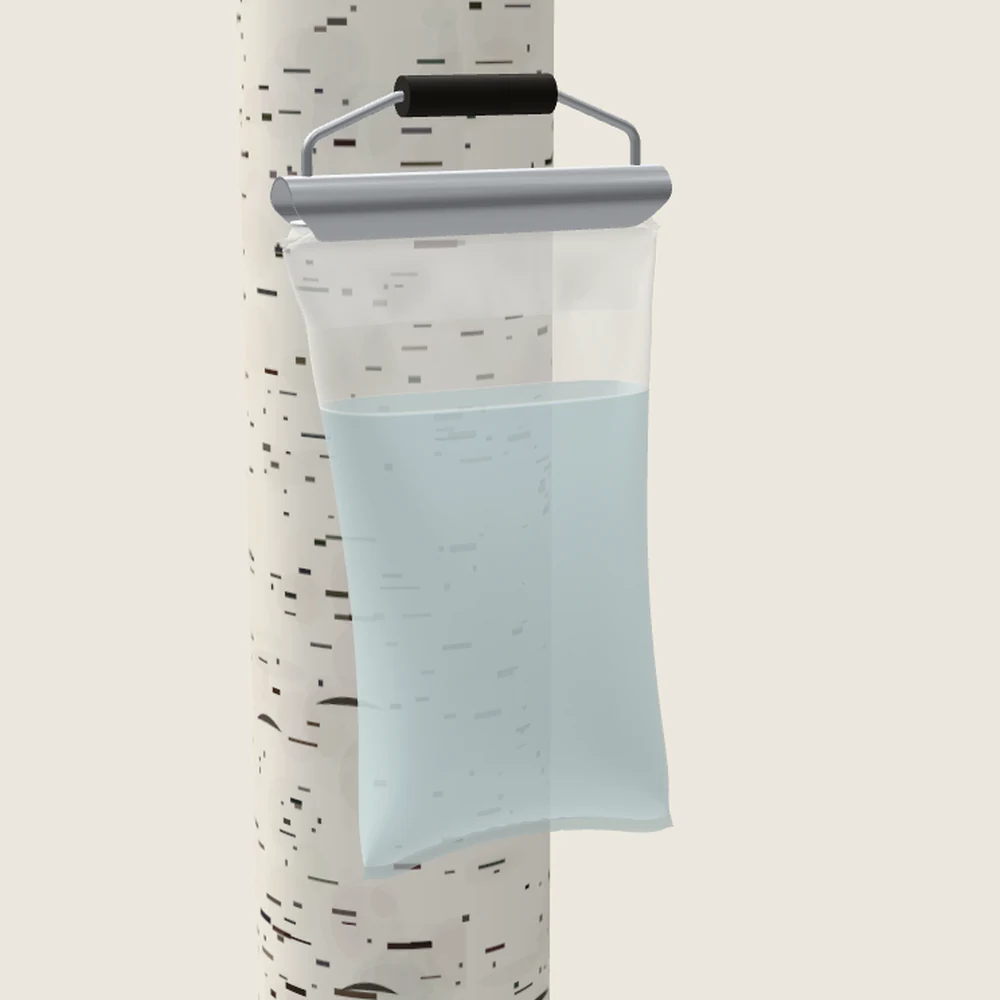
Fit the bag to the ring
Drop the bag through the ring and fold its edge over the rim. Ring and bag slide into the tube from the end.
Hang the holder on the spile
The keyhole in the tube goes over the spile and drops onto its collar. The handle stays free.
Let the tree fill it
Sap drips from the spile into the bag. The weight of the sap keeps the fold on the ring, up to 9 L.
Designed for 100 N on the tree, 200 N in the hand.
Sap drips into a plastic bag held open inside the holder.
When the bag is full, it goes to the car by hand, so the holder carries twice the weight for that walk.
| Property | Moulded | Stainless |
|---|---|---|
| Parts | Body and band | Tube and ring |
| Material | POM-C, 4 mm wall | 304 pipe, Ø48.3 × 2 mm |
| Tooling | Injection moulds | No mould |
| Carry handle | Strap, moulded with the body | Bar, welded to the tube |
| Safety factor, hanging 100 N | 1.27 | 1.15 |

Moulded: two POM-C parts.
The finding that set the material: plain PP fails at 4 mm in FEA. POM-C at the same wall passes hanging, the bag fold and carrying.
A body and a band, both moulded. The bag goes down through the band and folds back over its rim.
- 4 mm walls in POM-C, a food-contact acetal.
- A strap handle in one piece with the body: 120 mm between the legs, 34 mm of finger room, a 30 mm wide grip with R3 edges.
- Side grooves keep the strap section 11 mm thick and light, and the mould needs no slides for it.
- A keyhole for the spile, clear of the handle.
- Two lips at 135° hold the band; the bag leaves through the 16.5 mm gap between them.
- The band is 631.9 mm round, so the bags Libertu uses today still fit.
| Check | Result |
|---|---|
| FEA | |
| POM-C 4 mm, hanging 100 N for 1,000 hours | SF 1.27 |
| POM-C 4 mm, where the bag fold pulls on the lips | SF 1.56 |
| POM-C 4 mm, carried 200 N by the strap | SF 2.90 |
| Plain PP 4 mm, no handle, for comparison | SF 0.48, fails |
| In-use simulation | |
| Lean away from the tree when full, solved without the handle | 6° |
One check is still open: the drop. From 1.5 m at −10 °C, our calculation takes the strap feet past yield, so it does not show the holder survives. First moulded parts need a physical drop test.
Stainless: a tube and a flat ring, no mould.
A mould has to be paid for before the first holder is sold. Stock stainless pipe needs no tooling of its own.
The tube is 304 stainless pipe, Ø48.3 × 2 mm, 310 long. A laser cuts the keyhole, the end cuts and a slot along the bottom. The ring is laser cut from flat 2 mm sheet. Neither part is bent.
The ring has the same 631.9 mm perimeter as the moulded band.
The bag goes through the ring and folds back over it. The excess hangs out through the slot, and the pressure of the sap keeps the fold on the ring.
The handle, our addition
A full bag is carried, so we added a handle and checked it like the rest. It is a Ø8 stainless bar, bent and TIG welded to the tube top, with a Ø30 plastic grip 120 mm long. A gloved hand has 40 mm under the grip.
The margin is thin: 1.12 on the ring and 1.15 on the tube, both simulated, neither yet tested.
| Check | Result |
|---|---|
| FEA | |
| Tube peak stress, hanging, 304 | 119.1 MPa, SF 1.15 |
| Tube peak stress, carried 200 N | 99.2 MPa, SF 1.38 |
| Ring, bag fold pulling on its edge | 121.8 MPa, SF 1.12 |
| Simulation | |
| Slot direction when hung | 0.5° from straight down |
| Frame calculation | |
| Handle bar, carried 200 N | 81.8 MPa, SF 1.67 |
| Hand calculation | |
| Handle weld, 2 mm throat, carried 200 N | 27.8 MPa, SF 2.9 |
| CAD | |
| Clearance under the grip | 40 mm |
| Mass: tube, ring, handle, grip | 612 + 100 + 131 + 71 = 914 g |
Have your part checked the same way.
Send a STEP file of your part, moulded, machined or sheet metal. A written report comes back, and every finding names its rule.
What we designed, what Libertu supplied
- Ours: the moulded holder, the round-tube holder and its ring, the handle, the FEA, the CAD, the renders and this scene.
- Libertu's: the kit, its spile and its bags.
The numbers come from CAD and simulation, and each is labelled.